
LeNet: The Convolutional Net That Read Your Cheques
LeCun's convolutional network read handwritten cheques for AT&T10% of all cheques cleared in the US by 1998.
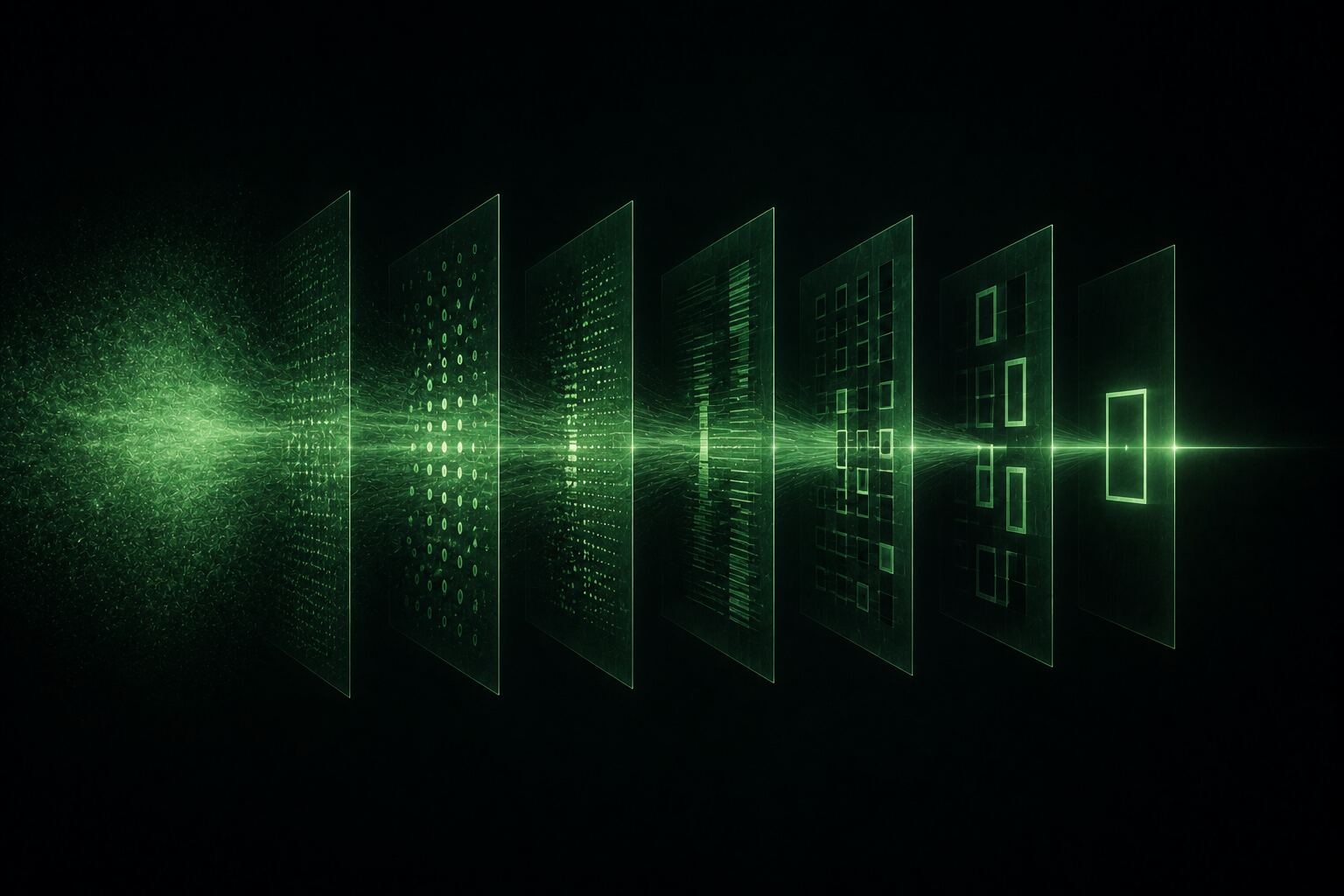
In 1989, Yann LeCun at AT&T Bell Labs published what would become one of the most consequential papers in computer vision: "Backpropagation Applied to Handwritten Zip Code Recognition." His system, later formalised as LeNet, used convolutional layers to detect local patterns (edges, curves, strokes) across an image, pooling layers to reduce spatial resolution, and fully connected layers at the end for classification. The architecture was directly inspired by the organisation of the mammalian visual cortex, which Hubel and Wiesel had mapped in the 1960s.
The key insight of convolutional networks was weight sharing. Instead of learning separate weights for every pixel position, the network learned a small filter, a pattern detector, and applied it everywhere across the image. This dramatically reduced the number of parameters, made the network translation-invariant (it could recognise a digit wherever it appeared), and made training practical on 1980s hardware.
By 1998, AT&T's systems based on LeCun's network were reading approximately 10% of all cheques processed in the United States. The bank couldn't tell you the specific network weights were reading your cheque, but they were. LeCun's architecture had made the jump from academic benchmark to industrial infrastructure, processing billions of dollars of transactions.
And then, almost nothing happened. The broader AI community largely ignored convolutional networks through the 1990s and early 2000s. SVMs were more theoretically tractable. Neural networks required GPUs that didn't yet exist in the right form. LeCun's group kept working, at AT&T, then at NYU, maintaining a small flame. When AlexNet won ImageNet in 2012 by a 10-point margin, it was essentially a much deeper LeNet trained on a GPU. The architecture LeCun had published in 1989 was 23 years old. It had just been waiting for hardware.
What it actually meant
LeNet sat in production reading cheques for a decade while the research community moved on to SVMs. The gap between working in production and being recognised by research can persist for years. Academic recognition and practical value are decoupled, which means both worlds regularly miss what the other knows.
What enterprises get wrong today
Enterprises adopt AI methods because they appear in recent papers or vendor announcements, not because they have been validated on the specific task. New architectures replace working systems before those systems have been properly evaluated. The research adoption cycle and the production validation cycle run at very different speeds.
Related capabilities
More from Models
Ask about this story
LeNet was reading 10% of US cheques by 1998a convolutional network doing industrial work two decades before "deep learning" became a term anyone used. Then it was largely ignored until 2012 proved it right. What would you like to explore?