
Hopfield Networks: Memory as Energy
John Hopfield showed that a network of neurons could function as an associative memorylike a brain that recalls the whole from a fragment.
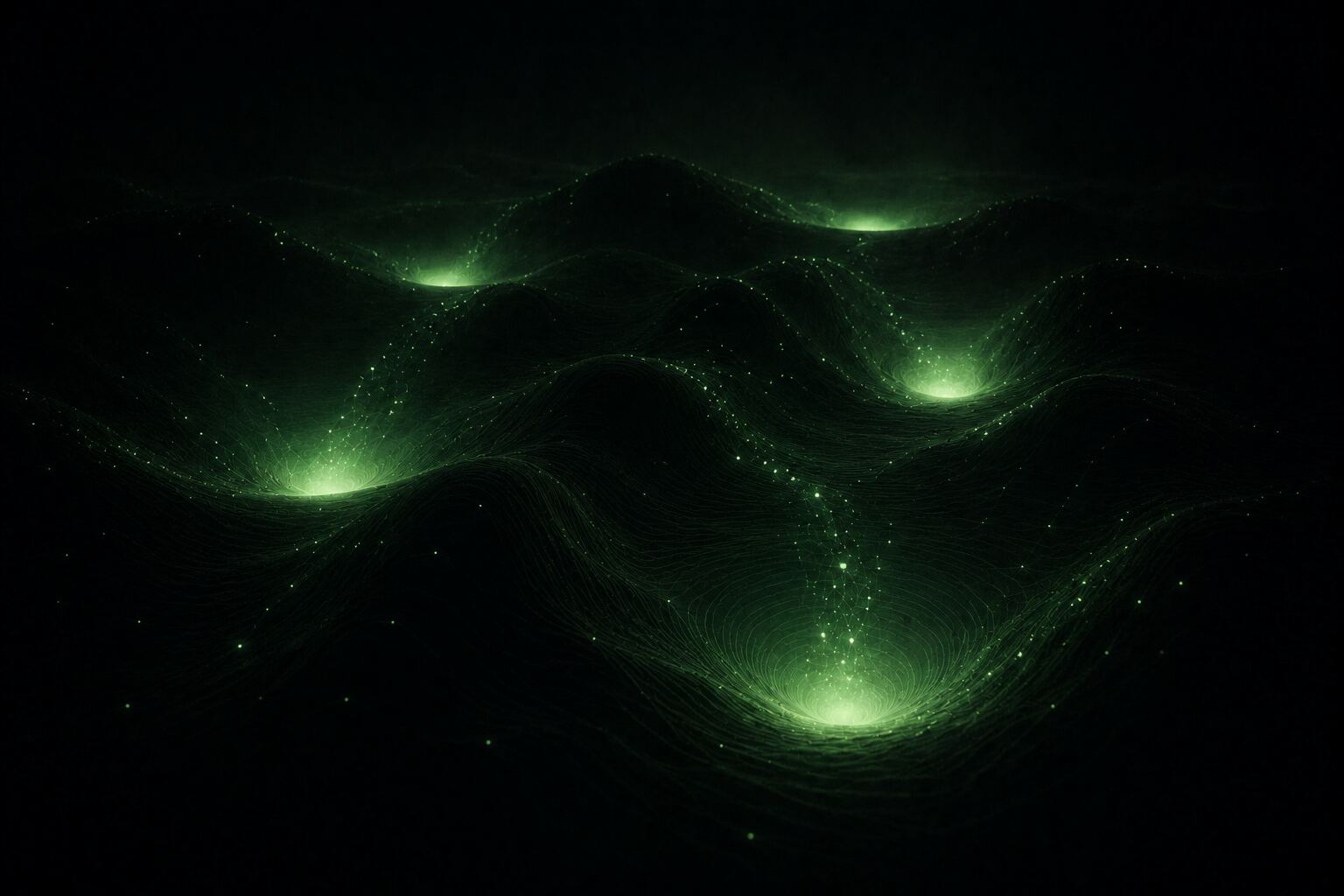
In 1982, John Hopfield, a physicist at Caltech, published a short paper in the Proceedings of the National Academy of Sciences that reimagined neural networks as physical systems. Instead of thinking about networks as computing machines, Hopfield thought about them as energy landscapes. A Hopfield network is a fully connected network of binary neurons that follows a simple rule: update each neuron to the state that reduces the total "energy" of the system. Given a corrupted or incomplete pattern, the network settles into the nearest memorised state, the lowest nearby energy valley.
The insight was profound: Hopfield networks are associative memories. Show the network a partial image, a corrupted pattern, or a fragment of something it has stored, and it will recall the complete original. This matched how human memory seems to work: you hear the first bars of a song and the whole melody follows. Hopfield's mathematical formalism made this intuition precise: memories are attractors in an energy landscape, and recall is gradient descent.
The paper directly inspired Geoffrey Hinton and Terry Sejnowski to develop the Boltzmann Machine in 1985, a stochastic version of the Hopfield network with hidden units that could learn from data through a process analogous to simulated annealing. The Boltzmann Machine became a key conceptual precursor to deep learning and variational autoencoders. Hinton's decades of work on these systems eventually led to his 2024 Nobel Prize, and he has consistently credited Hopfield as foundational.
Hopfield himself received the Nobel Prize in Physics in 2024, jointly with Hinton. The Nobel committee cited both for foundational discoveries that enabled machine learning with artificial neural networks. For Hopfield, this recognition came at 91. His 1982 paper, written by a physicist who thought the neuroscientists had been looking at neural networks the wrong way, became one of the most influential papers in the history of AI. The lesson: physicists thinking about energy landscapes sometimes discover the mathematics of memory.
What it actually meant
Hopfield showed that memory and energy minimisation are the same computation. A network remembers by settling into a low-energy state. This framing of intelligence as thermodynamics influenced variational autoencoders, energy-based models, and diffusion models that generate images today.
What enterprises get wrong today
Enterprises treat embedding-based retrieval as simple vector lookup without understanding that retrieval quality depends entirely on the geometry of the embedding space. Embeddings that cluster wrongly retrieve wrongly. Garbage in, garbage out applies to the latent space, not just the raw data.
Related capabilities
More from Models
Ask about this story
Hopfield showed that neural networks could work like associative memories: present a fragment, recall the whole. It's the same mathematics that Hinton used to build what eventually became deep learning. Both won the Nobel Prize in 2024. What would you like to explore?